
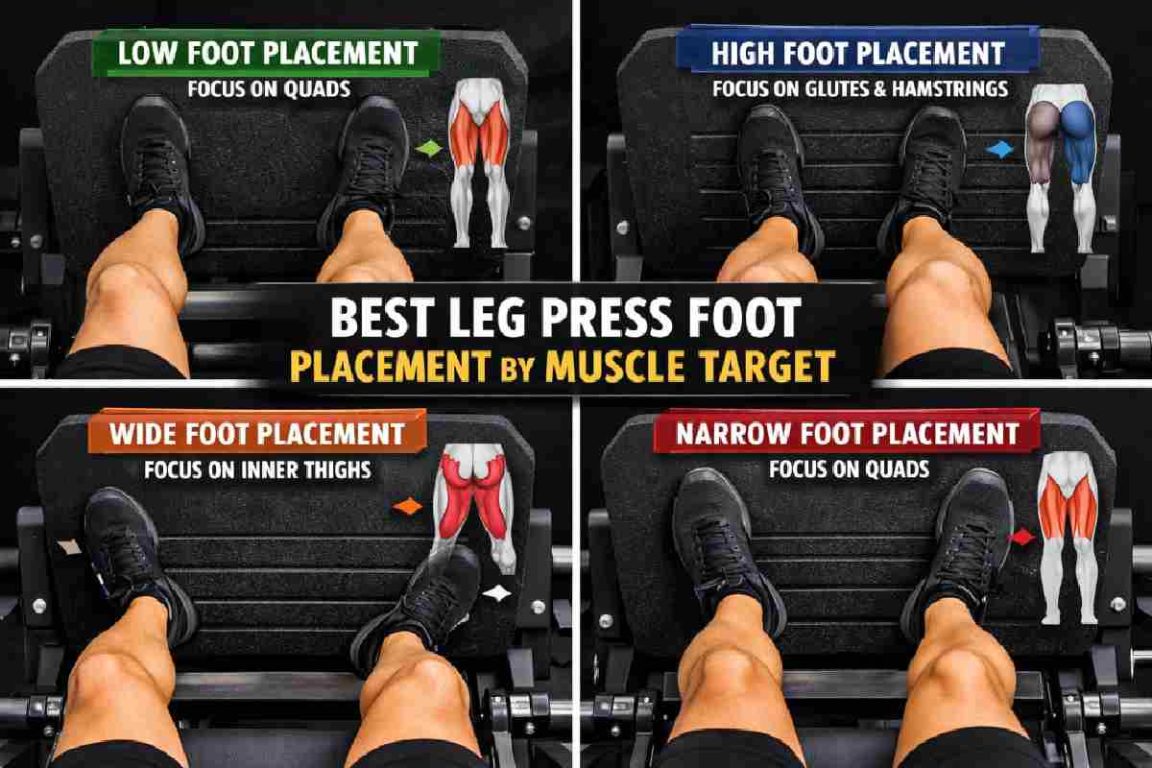
If you’ve ever wondered whether leg press foot placement really changes which muscles you train, the short answer is yes—but only when done correctly.
Where you place your feet on the leg press platform can slightly shift the emphasis between your quads, glutes, hamstrings, and inner thighs. But here’s what most gym guides miss: foot placement only helps if your range of motion, joint alignment, and load selection are also right.
That means simply moving your feet higher or wider won’t magically “isolate” a muscle if your knees cave in, your hips tuck under, or you’re loading more weight than you can control.
This guide breaks down exactly how foot placement works, what each setup actually does, and how to choose the best one for your goals.
What Is Leg Press Foot Placement?
Leg press foot placement refers to where and how you position your feet on the platform during a leg press exercise to influence comfort, joint angles, and muscle emphasis.
It affects things like:
- Knee travel
- Hip flexion
- Ankle range of motion
- Depth
- Stability
- Which muscles feel more challenged
That’s important because the leg press is often used for:
- Building lower-body muscle
- Increasing training volume safely
- Reducing balance demands compared with squats
- Training around certain mobility limitations
But it can also go wrong fast if your setup forces poor mechanics.
Why Foot Placement Matters on the Leg Press
The leg press is a machine-based movement, but it’s not “mindless.” Small setup changes can influence how your body moves.
Here’s what foot placement can affect most:
- Quad involvement
- Glute and hamstring contribution
- Knee comfort
- Hip comfort
- Depth and range of motion
- Lower back positioning
What it does NOT do
It does not completely isolate one muscle and “turn off” the others.
For example:
- A low foot placement can make the exercise feel more quad-heavy.
- A high foot placement can make it feel more glute/hamstring-heavy.
- But your quads, glutes, and hamstrings are still all working.
Think of foot placement as a bias tool, not a magic switch.
Best Leg Press Foot Placement by Muscle Target
Here’s the easiest way to understand it:
| Foot Placement | Main Emphasis | Best For | Watch Out For |
|---|---|---|---|
| Low on platform | Quads | Front thigh development | More knee bend, ankle mobility demand |
| High on platform | Glutes, hamstrings | Posterior chain focus | Can reduce control if too high |
| Narrow stance | Quads, overall leg drive | Balanced leg development | Knee tracking issues if too narrow |
| Wide stance | Adductors, glutes | Inner thigh and glute contribution | Hip discomfort if forced |
| Toes slightly out | Natural hip alignment | Most lifters | Over-rotating feet |
| Feet neutral/straight | Controlled pressing | Lifters with good hip mechanics | May feel awkward for some bodies |
Let’s break each one down.
Low Foot Placement on Leg Press: More Quad Emphasis
Placing your feet lower on the platform usually increases knee flexion and can make the movement feel more centered in the quads.
When to use it
Use a lower foot placement if your goal is:
- More front-thigh development
- Better quad stimulus after squats or lunges
- Hypertrophy-focused leg training
How it should feel
You’ll usually notice:
- More knee bend
- More tension through the front of the thighs
- A stronger “burn” in the quads
Common mistake
Going too low can cause your heels to lift or your knees to feel overloaded.
Best cue
Keep your full foot planted—especially your heel and midfoot.
If your heels pop up, your foot placement is likely too low for your mobility.
High Foot Placement on Leg Press: More Glute and Hamstring Bias
Placing your feet higher on the platform often increases hip flexion and can shift more of the work toward the glutes and hamstrings.
When to use it
This setup is useful if you want:
- More glute training without barbell loading
- Extra posterior-chain volume
- A lower-body variation that feels less knee-dominant
How it should feel
You may notice:
- More stretch at the hips
- More effort in the glutes on the way up
- Slightly less quad “burn” compared with a low placement
Common mistake
Many people place their feet so high that their range of motion becomes too short or unstable.
Best cue
Set your feet high enough to feel the glutes and hamstrings—but not so high that your knees lose a strong pressing path.
Wide Foot Placement on Leg Press: More Adductor and Glute Involvement
A wider stance can increase contribution from the inner thighs (adductors) and may also help some lifters feel their glutes more.
When to use it
A wide stance may help if you:
- Want more adductor involvement
- Feel cramped in a narrow stance
- Have hip anatomy that prefers more external rotation
How wide is too wide?
If you feel:
- Hip pinching
- Lower back rounding
- Uneven pressure through your feet
…it’s probably too wide.
Best cue
Choose a stance where your knees track in line with your toes, not inward.
Narrow Foot Placement on Leg Press: More Quad Feel, Less Hip Demand
A narrower stance often reduces hip demand and can make the leg press feel more direct and quad-focused.
When to use it
Try it if you:
- Want a compact, controlled pressing pattern
- Prefer a more athletic stance
- Feel stronger with feet closer together
Potential downside
Too narrow can cause:
- Knees drifting inward
- Reduced stability
- An awkward pressing path
Best cue
Keep your feet hip-width to slightly narrower, not glued together.
What Is the Best Overall Leg Press Foot Placement?
For most people, the best setup is:
Best starting position
- Feet about shoulder-width apart
- Toes turned out slightly
- Feet placed around the middle of the platform
- Knees tracking in line with toes
- Full foot contact during the entire rep
This gives you:
- Good balance between quads and glutes
- Better stability
- Easier knee tracking
- A safer starting point before experimenting
If you’re not sure where to begin, start here.
Leg Press Foot Placement for Different Goals
For quad growth
Use:
- Lower foot placement
- Medium to narrow stance
- Controlled depth
- Higher-rep sets
For glute growth
Use:
- Slightly higher foot placement
- Medium to slightly wide stance
- Deep but controlled reps
- Strong lockout without snapping knees
For hamstrings
The leg press is not the best hamstring isolation exercise, but a higher placement can increase their contribution.
Better hamstring-focused additions:
- Romanian deadlifts
- Seated leg curls
- Hip hinges
For inner thighs
Use:
- Slightly wider stance
- Toes slightly turned out
- Controlled descent
- Full range without hip discomfort
Who This Is Best For
Understanding leg press foot placement is especially useful for:
- Beginners learning lower-body mechanics
- Intermediate lifters trying to improve muscle targeting
- People training for hypertrophy
- Lifters who want to reduce balance demands
- Gym-goers working around squat limitations
It can also be useful if you:
- Have long legs and struggle with squat depth
- Want extra leg volume after compound lifts
- Need a more stable lower-body movement
Who Should Be Cautious
You should be more careful with leg press variations if you have:
- Existing knee pain
- Hip impingement symptoms
- Lower back sensitivity
- Limited ankle mobility
- A habit of letting your pelvis roll under at the bottom
If that sounds familiar, the issue may not be the machine itself—it may be your depth, load, or setup.
If pain is sharp, persistent, or worsening, stop and get it assessed by a qualified physio or sports clinician.
How to Find Your Best Leg Press Foot Placement
Here’s the simplest way to personalize it.
Step 1: Start in the middle
Place your feet:
- Mid-platform
- Shoulder-width apart
- Toes slightly out
Do 8–10 slow reps.
Step 2: Notice where you feel it
Ask:
- Mostly quads?
- More glutes?
- Any knee discomfort?
- Any hip pinching?
- Any low back rounding?
Step 3: Adjust one thing at a time
Only change one variable:
- Move feet slightly higher or lower
- Go slightly wider or narrower
Avoid changing everything at once.
Step 4: Keep the same depth
If you compare foot placements, keep your depth and load similar.
Otherwise, you’re not testing placement—you’re testing a different exercise.
5 Common Leg Press Foot Placement Mistakes
1. Placing feet too low
This can:
- Lift your heels
- Stress your knees
- Reduce force production
2. Going too high and too wide
This often shortens range of motion and makes the movement awkward.
3. Letting the lower back round
This is one of the biggest mistakes on the leg press.
Fix it
Only lower the sled as far as you can while keeping your hips and lower back stable.
4. Locking out hard at the top
You don’t need to slam into knee lockout to complete a rep.
5. Chasing weight instead of quality
A heavy leg press with poor mechanics is usually less useful than a controlled one with better depth and tension.
Myths vs Facts About Leg Press Foot Placement
Myth: High feet completely isolate glutes
Fact: It may bias glutes more, but your quads still work hard.
Myth: Low foot placement is bad for knees
Fact: It can be fine for many people if your form, load, and mobility are appropriate.
Myth: Wide stance is always better for glutes
Fact: Not always. Too wide can reduce output and create hip discomfort.
Myth: The leg press is safer no matter how you do it
Fact: It’s stable, but poor setup and excessive loading can still create problems.
How Deep Should You Go on the Leg Press?
The best depth is the deepest position where you can keep:
- Full foot pressure
- Knees aligned
- Hips stable
- Lower back against the pad
That’s your real working depth.
Not everyone needs the same range.
A good rep should look like this:
- Controlled lowering
- No bouncing
- No pelvis tucking under
- Smooth press back up
Depth should be based on control, not ego.
Best Rep Range for Leg Press
Your foot placement matters, but so does your programming.
For muscle growth
- 8–15 reps
- 2–4 working sets
- Controlled tempo
- Close to muscular fatigue
For strength support
- 5–8 reps
- Heavier load
- Strong form
- Longer rest periods
For beginners
- 10–12 reps
- Moderate load
- Learn control before chasing intensity
Practical Example: Which Foot Placement Should You Use?
Here’s a simple real-world guide:
Use lower placement if:
- You want bigger quads
- You feel too much glute dominance
- You want more front-leg tension
Use higher placement if:
- You want more glute bias
- Your knees dislike very knee-dominant reps
- You’re adding posterior-chain volume
Use wider placement if:
- You want more inner-thigh contribution
- Narrow stance feels cramped
Use neutral placement if:
- You want balanced leg development
- You’re still learning your best setup
- You want the safest all-purpose option
Final Verdict on Leg Press Foot Placement
The best leg press foot placement depends on what you want to train and what your body tolerates best.
If you remember just one thing, make it this:
Foot placement should improve muscle targeting without ruining your joint mechanics.
For most people, the smartest approach is:
- Start with a neutral setup
- Adjust based on comfort and muscle feel
- Keep your full foot planted
- Use controlled depth
- Stop chasing extreme positions for “muscle hacks”
That’s how you make the leg press actually work for you—not just feel different.
FAQs
What foot placement is best for quads on leg press?
A lower foot placement usually creates more quad emphasis because it increases knee flexion and makes the movement feel more knee-dominant.
Does high foot placement work glutes more?
Yes, a higher foot placement often increases glute and hamstring involvement by shifting the movement slightly more toward the hips.
Is wide foot placement better on the leg press?
Not always. A wide stance can increase adductor and glute involvement, but only if it feels natural and doesn’t cause hip or back discomfort.
Where should your feet go on a leg press machine?
For most people, the best starting point is mid-platform, shoulder-width apart, with toes slightly turned out and full foot contact.
Can leg press foot placement reduce knee pain?
Sometimes. Adjusting foot placement may improve comfort, but pain can also come from excessive load, poor depth control, or existing joint issues.
Should your heels lift during leg press?
No. Your heels should stay planted throughout the movement to maintain stability and reduce unnecessary stress on the knees and ankles.
Is leg press better than squats for muscle growth?
Not necessarily better, but it can be very effective for hypertrophy because it allows you to train hard with more stability and less balance demand.