
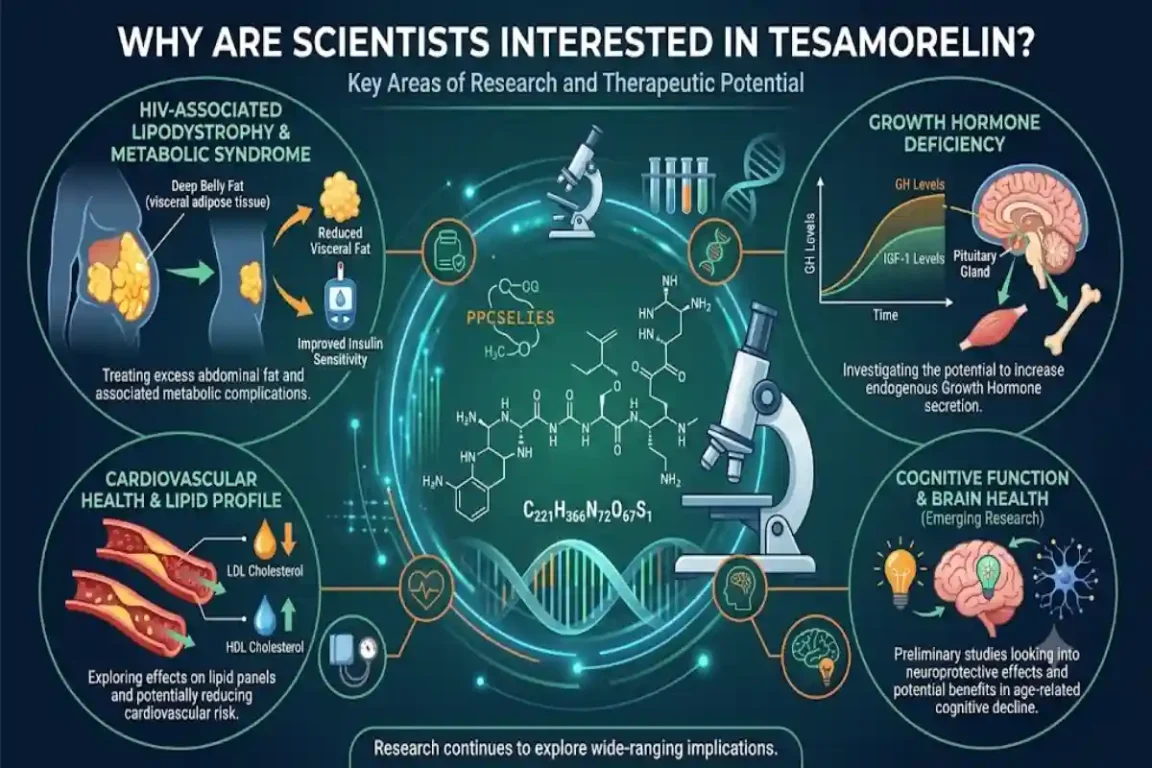
Studies on tesamorelin have gone beyond visceral fat. It is a growth hormone-releasing hormone analog that provides researchers with an approach to examining the impact of alterations in the GH/ IGF-1 axis on:
- Fat distribution
- Liver health
- Other metabolic pathways.
Below, we discuss some key areas of research for tesamorelin.
Visceral adipose tissue reduction
Visceral adipose tissue is one of the oldest fields of research. Clinical studies have shown meaningful visceral fat loss after tesamorelin administration.
Some studies report 15% to 20% loss after 26 weeks. Interestingly, the effect is not just a general reduction in all body fat. It has been found that visceral deposits are more affected than subcutaneous or limb fat.
This allows researchers to investigate whether hormonal signaling can influence specific fat depots.
HIV-associated lipodystrophy
The drug has also been studied in detail for the use of treating HIV-associated lipodystrophy. Antiretroviral therapy may be associated with altered body fat distribution such as increased abdominal visceral fat.
This research has focused on variations in VAT, waist circumference, and related measurements. Some research has also examined patient-reported outcomes such as perceptions of body shape and body image.
This study serves as a helpful model for researchers to investigate how specific alterations in visceral fat are associated with overall metabolic and physical consequences.
Liver fat and metabolic liver disease
The other area of active research is hepatic fat. Researchers are examining the possibility that a reduction of visceral adiposity by modulation of the GHRH axis could also have a beneficial effect on liver fat.
They are examining outcomes such as:
- Liver fat content
- Markers of inflammation
- Measures associated with fibrosis.
This is especially important since pathways of visceral fat, insulin resistance, and metabolic dysfunction may overlap with metabolic liver disease. Much of the interest has focused on understanding how this works.
GH/IGF-1 Axis modulation
The research on tesamorelin Canada is often focused on the GH/IGF-1 axis at the mechanistic level. Tesamorelin is not a growth hormone. But rather a GHRH analog and stimulator of endogenous growth hormone production.
Researchers can thus study the relationship between alterations in body composition and changes in GH secretion and downstream IGF-1 levels. There have been studies that report alterations in lean body mass in addition to visceral fat.
This is an important area to understand the relationship between hormonal signaling and tissue composition.
Cardiometabolic outcomes
Researchers have also studied whether or not shifts in visceral fat are correlated with shifts in metabolic biomarkers. These investigations include:
- Lipid measures such as triglycerides and cholesterol
- Inflammatory markers including C-reactive protein (CRP).
These findings expand beyond just VAT to help investigate whether fat distribution changes with other metabolic changes.
Emerging research areas
Other less developed fields are cognition and aging. Researchers are exploring whether modulation of GHRH-related pathways has neurological or cognitive associations.
The other one is analytical detection. Sports science and analytical laboratories are working on methods to detect GHRH analogs in blood samples, as they are banned in anti-doping regulations.
Summing up
The research on tesamorelin is grouped under the themes of:
- Body-fat distribution
- Endocrine signalling
- Liver metabolism
- Biomarkers
- Analytical science.
These areas offer various approaches for the study of the effect of modulation of the GHRH-axis on particular biological systems.