

In general an old Work Order ID can be used as long as the related record is kept in the organization’s system. The ID itself may become forever part of the record history. However to know whether an old work order may be edited, re-opened, cloned or used multiple times it depends on the software, record retention rules, security and workflow settings.
How Old Can a Work Order ID Be Used?
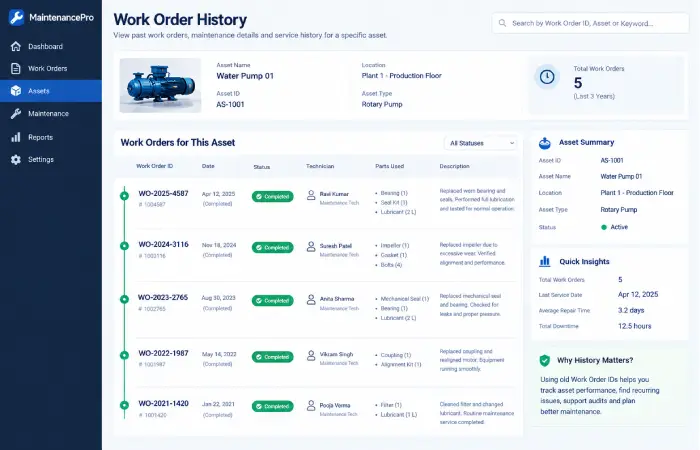
A Work Order ID is typically used to identify a particular work order within the existing system (maintenance, field-service, asset-management or a business system).
If you have the Work Order ID you are trying to search for, you should also still be able to pull and use this a reference although the original work order was generated months or years previously.
However, there is an important distinction:
An old Work Order ID can remain useful for historical reference without necessarily being reusable for a new job.
The actual rules depend on the software platform, database-retention policy, user permissions and organisation’s workflow.
For example, ServiceNow’s Field Service Management documentation describes work orders as records that contain information about requested work and associated tasks, and its system gives work orders defined lifecycle states.
Does a Work Order ID Expire?
Usually, the ID itself does not automatically become invalid simply because the work order is old.
But this does not mean that every old Work Order ID can be used in exactly the same way.
There are several possibilities:
- The work order remains active in the database.
- The work order is completed but remains searchable.
- The record is archived.
- The record is retained for reporting but cannot be edited.
- The record is deleted according to a retention policy.
- The user no longer has permission to access it.
This is why there is no universal rule such as “a Work Order ID expires after one year.”
Different systems have different record-management policies.
For example, Salesforce states that a record ID is generated when a record is created and that the Record ID does not change even if the record is deleted and later undeleted.
That illustrates an important principle: record identifiers and record availability are two different things.
How Long Can You Use an Old Work Order ID?
An old Work Order ID can potentially remain useful for months, years, or even longer, provided that the underlying record remains available to you.
The practical lifespan depends on:
1. Database Retention
The organisation may have a policy determining how long completed work orders are retained.
A company might retain maintenance records for several years, while another organisation may archive or delete older records sooner.
2. Software Configuration
Different platforms handle old work orders differently.
For example, ServiceNow Field Service Management uses work-order states and allows work orders to be managed throughout their lifecycle.
3. User Permissions
Even if an old Work Order ID still exists, you may not have permission to open, edit or modify the record.
4. Archive Policies
Older records may be moved to an archive rather than deleted.
In that situation, the ID may still be valuable for historical searches or reporting, but the normal work-order screen may not behave the same way.
5. Business Rules
An organisation may have rules preventing users from modifying completed or closed work orders.
Therefore, “Can I find the old ID?” and “Can I reuse the old ID?” are two different questions.
Can You Use an Old Work Order ID for Historical Reference?
Yes, if the record is still accessible.
This is one of the most useful purposes of an old Work Order ID.
A maintenance team might use an old work order to determine:
- What repair was performed
- Which technician completed the job
- Which parts were replaced
- How many labour hours were recorded
- What equipment was serviced
- What the previous problem was
- How much the repair cost
- When the work was completed
Work orders are specifically designed to contain information about requested work and the tasks needed to complete it.
Example
Imagine an organisation has a machine called Pump-204.
A technician discovers that the machine is malfunctioning in 2026.
The maintenance manager searches the history and finds an old Work Order ID from 2023.
That record shows:
- Pump-204 was repaired in 2023.
- A particular component was replaced.
- The repair required several hours of labour.
- The same type of failure occurred previously.
The old Work Order ID therefore becomes useful even though the original job was completed years earlier.
1. Use an Old Work Order ID for Historical Reference
One of the main reasons to keep old Work Order IDs is to maintain an equipment or service history.
You can use an old record to understand what happened previously.
This is especially valuable for:
- Equipment maintenance
- Vehicle servicing
- Building repairs
- IT infrastructure
- Manufacturing machinery
- Facilities management
- Field-service operations
A history of previous work can help technicians make better decisions when the same asset develops another problem.
2. Use Old Work Order IDs for Auditing
Old Work Order IDs can also be useful during an audit.
For example, an organisation may need to verify:
- Labour hours
- Parts used
- Technician assignments
- Service dates
- Maintenance costs
- Approval information
- Completion details
Instead of searching through thousands of general records, an auditor can use the Work Order ID to locate the specific job.
This can make historical investigation considerably easier.
Important: Whether an old record can be changed during or after an audit depends on the software’s permissions and the organisation’s controls.
3. Use Old Work Order IDs for Warranty Claims
An old Work Order ID can sometimes help establish that a particular repair or maintenance activity occurred.
For example:
A component was replaced in March 2025, but it fails again in September 2026.
The original Work Order ID may provide evidence about:
- The date of installation
- The part used
- The technician
- The service performed
- The original problem
Whether this is sufficient for a warranty claim depends on the warranty terms and the manufacturer’s requirements.
4. Can You Reuse an Old Work Order ID?
This is where users need to be careful.
Generally, you should not assume that an old Work Order ID can simply be reused for a completely new job.
A Work Order ID normally identifies a particular record.
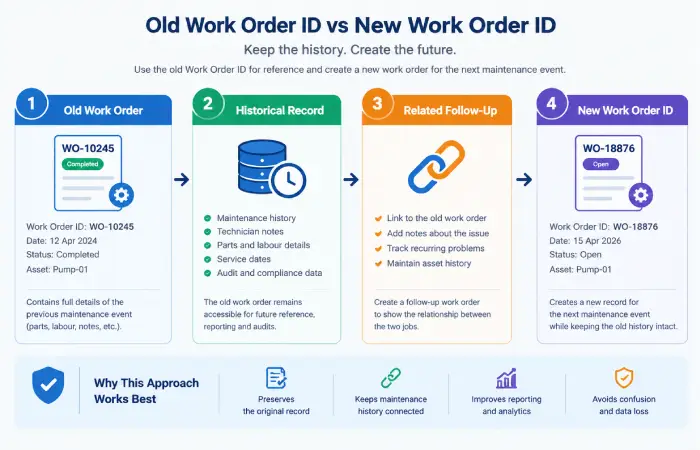
If a new maintenance event occurs, many systems are designed to create a new work order rather than overwrite the historical record.
ServiceNow, for example, allows a new work order to be created from an existing work order when circumstances require it, with relevant information copied from the original record.
This preserves the relationship between the old and new work.
Better approach
Instead of changing an old Work Order ID:
Old Work Order → New Work Order → Link the two records
This keeps the maintenance history cleaner.
5. Can an Old Work Order Be Reopened?
Sometimes, but it depends on the software and workflow.
A completed work order may have reached a final state where editing is restricted.
If the original repair fails shortly after completion, an organisation might:
- Reopen the existing work order, if the system allows it.
- Create a follow-up work order.
- Create a new work order linked to the original.
The third approach can often provide clearer reporting because the original record remains an accurate historical record.
ServiceNow’s documentation shows that work orders move through configured lifecycle states, so the actions available on an old work order depend on how the organisation has configured its workflow.
6. Use an Old Work Order ID to Create a Follow-Up
A previous Work Order ID can be extremely useful when the same issue happens again.
For example:
WO-10245 — Motor repair — 2024
↓
WO-18763 — Same motor failure — 2026
The second work order can reference the first.
This gives technicians immediate access to the previous repair history.
It also helps organisations identify repeated failures.
7. Can an Old Work Order Be Cloned?
Some systems allow an existing work order or task to be used as the basis for a new record.
The important distinction is that cloning creates a new record; it does not turn the old record into the new job.
ServiceNow documentation, for example, describes creating work orders from existing work orders and copying relevant information into the new record.
This can be useful when maintenance work is repetitive.
For example:
Original Work Order
- Equipment: Air Compressor
- Maintenance type: Preventive maintenance
- Parts: Filter + oil
- Estimated labour: 2 hours
New Work Order
The organisation can use the previous information as a starting point while generating a new Work Order ID for the new maintenance event.
8. Use Old Work Order IDs for Maintenance Analytics
Historical Work Order IDs can provide valuable information for reporting.
Organisations can analyse old work orders to identify:
- Frequently failing equipment
- Repeated repair types
- Maintenance costs
- Technician workloads
- Average repair duration
- Recurring component failures
- Maintenance frequency
This historical data can support metrics such as Mean Time Between Failures (MTBF) and lifecycle-cost analysis.
The value increases when work orders contain consistent information about assets, tasks, parts and labour.
How Old Work Orders Help Identify Recurring Problems
Suppose a factory has 500 machines.
One machine has the following history:
| Year | Work Order | Problem |
| 2022 | WO-22014 | Motor overheating |
| 2023 | WO-23187 | Motor overheating |
| 2024 | WO-24092 | Bearing replacement |
| 2025 | WO-25144 | Motor overheating |
| 2026 | WO-26031 | Motor overheating |
Looking at individual work orders may not immediately reveal the pattern.
Looking at the historical Work Order IDs together shows that the same machine repeatedly experiences similar problems.
That information can support a decision to investigate the underlying cause rather than repeatedly performing temporary repairs. For more related articled visit our website.
What If the Old Work Order ID No Longer Works?
If searching for an old Work Order ID produces no result, several explanations are possible.
The record may have been archived
The record may still exist but have moved into an archive.
The record may have been deleted
Some organisations have defined retention periods.
The system may have changed
A company may have migrated from one work-order platform to another.
Your permissions may have changed
The record can exist while your current account no longer has access.
The ID may be incorrect
A single incorrect character can prevent a search from returning the expected record.
The Work Order ID may belong to another system
Some organisations use multiple systems for maintenance, facilities, IT or field service.
How to Find an Old Work Order ID
If you have an old ID, start with the system where the work was originally recorded.
Search using the exact ID first.
If that fails, try related information such as:
- Asset number
- Customer name
- Equipment name
- Location
- Technician
- Service date
- Work description
- Invoice number
- Purchase order
- Related ticket number
If the organisation migrated systems, ask whether historical work orders were transferred to the new platform or stored in an archive.
Old Work Order ID vs New Work Order ID
| Feature | Old Work Order ID | New Work Order ID |
| Historical reference | Yes | Not yet |
| Audit evidence | Often useful | Future use |
| Previous repair history | Yes | No |
| New maintenance event | Usually not reused | Yes |
| Reporting | Yes | Yes |
| Follow-up reference | Yes | Can link to old ID |
| Cloning source | May be possible | Not applicable initially |
The safest practice is generally to preserve the old Work Order ID and create a new ID for a new event, unless your specific software workflow says otherwise.
Best Practices for Managing Old Work Order IDs
Keep Historical Records Intact
Avoid changing historical information simply to represent a new job.
Link Related Work Orders
When the same asset or problem appears again, link the new work order to the previous record where the software supports relationships.
Follow Retention Policies
Keep records according to your company’s legal, financial and operational requirements.
Restrict Editing of Completed Work
Historical records are more valuable when users cannot casually change important details after completion.
Use Consistent Asset Information
Accurate asset numbers make historical work-order analysis much easier.
Document Why a New Work Order Was Created
If a follow-up job relates to an old work order, record the relationship clearly.
Frequently Asked Questions
How old can a Work Order ID be used?
There is no universal maximum age. An old Work Order ID can remain useful for as long as its underlying record is retained and accessible. The ability to edit, reopen or reuse it depends on the software and organisation’s configuration.
Does a Work Order ID expire?
Not necessarily. An ID may continue to identify a historical record even after the work order has been completed or closed. However, the record may eventually be archived or deleted according to retention rules.
Can I reuse an old Work Order ID?
Usually, you should not assume that you can reuse an old ID for a new job. A new work order and new ID are often preferable so that each maintenance event has its own history.
Can a closed Work Order be reopened?
Some systems allow certain closed records to be reopened, while others require a new work order. Check your platform’s workflow and permissions.
Can an old Work Order ID be used for an audit?
Yes, if the historical record remains accessible. It can help locate information about work performed, parts, labour and completion details.
Can an old Work Order be used to create a new one?
Some platforms allow a new work order to be created from an existing work order. ServiceNow, for example, documents creating new work orders from existing work orders and copying relevant information.
What happens if an old Work Order ID cannot be found?
Check whether the record was archived, deleted, migrated to another system, restricted by permissions or entered incorrectly.
Conclusion
So, how old can a Work Order ID be used?
There is no single expiration period that applies to every Work Order ID. An old ID can remain useful for years when the associated record is retained and accessible.
The most important distinction is between using an old Work Order ID as a historical reference and reusing it for new work. Historical IDs can help with maintenance history, audits, warranty documentation, recurring-problem analysis and reporting. For a new maintenance event, however, creating a new Work Order ID and linking it to the previous record is often the cleaner approach.
The exact answer ultimately depends on the work-order software, database-retention policy, permissions and workflow rules used by your organisation.