
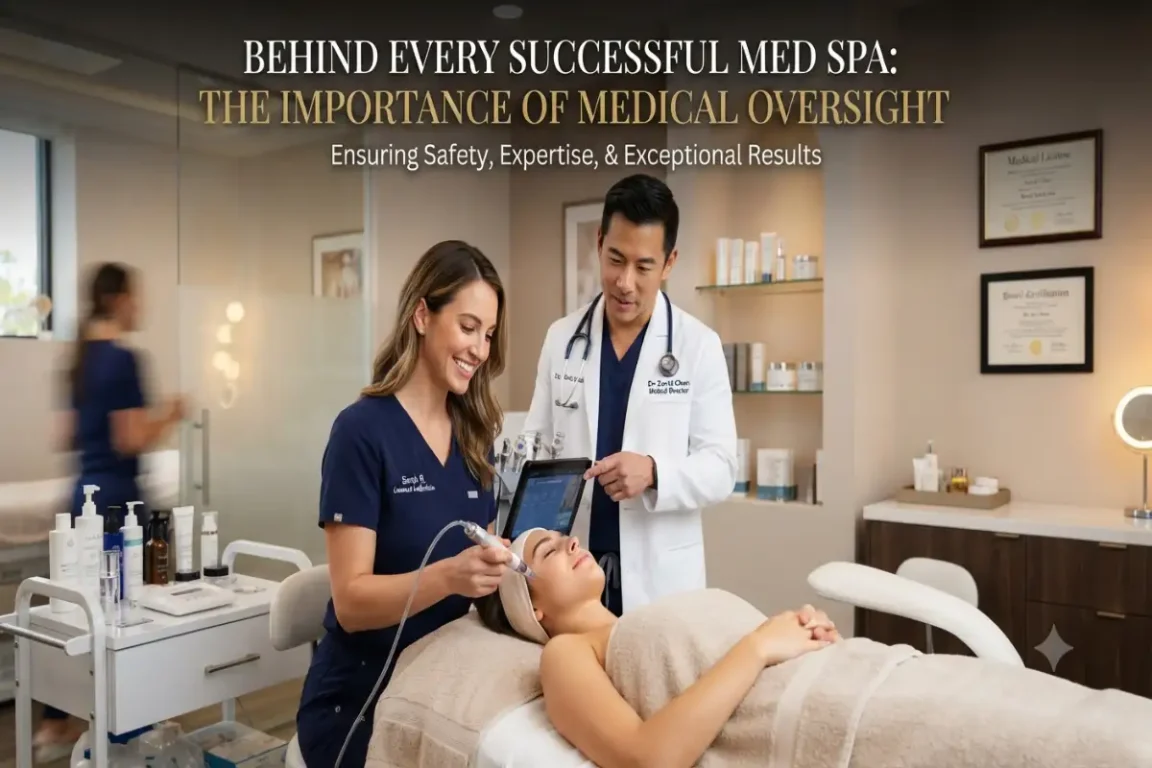
A medical director for med spa operations helps connect the beauty experience patients expect with the clinical safeguards medical aesthetic services require. Behind a polished treatment room are important decisions about patient screening, professional scope, consent, supervision, emergency readiness, and follow-up. Each one shapes how safely and consistently a clinic delivers care.
A successful practice needs more than skilled providers and attractive results. When owners explore a medical director for med spa partnership, they should look beyond a name on the paperwork and understand what meaningful oversight involves. This guide explains how that clinical support strengthens daily operations and which questions to ask before choosing a partner.
Key Takeaways
- Medical oversight is an ongoing clinical responsibility, not just a signed agreement.
- Patient assessment, informed consent, and follow-up are essential parts of aesthetic care.
- Training, legal scope of practice, delegation, and supervision must each be verified.
- Complication protocols and reliable escalation paths help teams respond appropriately.
- A well-defined medical director relationship supports accountable, sustainable growth.
What Does Medical Director Oversight Actually Look Like?
Medical director oversight in a med spa is an ongoing clinical function, not a name printed on a website. Depending on the state, the practice model, and the treatments offered, appropriate oversight may involve establishing clinical policies, reviewing provider qualifications, defining delegation, and being available for medical questions. It may also include direct patient assessment, chart review, or onsite activity when applicable law requires those steps. Owners should identify the exact duties required before assuming that a standard contract will cover them.
A useful starting point is the service menu. Each offering should have a clear answer to who evaluates the patient, who decides whether treatment is appropriate, who may perform it, and who manages unexpected outcomes. That exercise often reveals gaps hidden by everyday routines. For example, a clinic might have a skilled injector but no consistent process for escalating a contraindication or documenting a declined treatment. An effective medical director can help clarify those decision paths and work with the team to refine them.
Oversight also needs a workable rhythm. Scheduled case discussions, periodic policy reviews, training reviews, and a defined method of reaching the appropriate clinician help turn written expectations into practice. The goal is not to slow every appointment. It is to make the clinical responsibilities visible and repeatable so that patient care does not depend on whoever happens to be working that day.
A Signature Is Not a Patient Safety Program
A medical director for med spa operations should provide meaningful oversight rather than only signing paperwork. A title or agreement cannot replace actual involvement when the applicable standards call for supervision, prescribing decisions, chart review, or clinical evaluation. The owner and clinician should discuss how those responsibilities will happen in real life before the clinic adds a treatment to its menu.
Start by mapping the moments when a provider needs guidance. These may include an unclear medical history, a request outside a practitioner’s approved scope, a patient who does not meet treatment criteria, or an adverse reaction after a procedure. Then confirm who receives the question, how promptly the clinician can respond, and where the conversation is recorded. If no one can explain the pathway, the operational plan is incomplete even if every agreement has been signed.
The same principle applies to changes in staffing. A new employee may bring experience from another state, but previous experience does not automatically establish authority to perform a service in the current location. Competency assessments, license verification, and the applicable rules must be considered together. Medical leadership has value when it helps staff recognize their limits and obtain support early. That is a stronger foundation for consistent care than relying on the director’s name as a marketing credential.
Why Does Patient Screening Matter as Much as the Results?
Medical oversight for aesthetic treatments begins before the first injection, device session, or procedure. A med spa may focus its marketing on visible outcomes, yet clinical decisions depend on the patient’s history, current condition, treatment goals, and individual risk factors. An attractive before-and-after photo cannot establish whether a procedure is appropriate for the person sitting in the consultation room. Screening is where the team identifies reasons to modify, delay, decline, or refer a treatment.
A structured process can help staff gather relevant information consistently. Depending on the treatment, the team may need to consider medications, allergies, prior procedures, infection concerns, healing issues, pregnancy status, or other medical factors. Not every staff member has authority to interpret those findings or make a medical decision. The director and other authorized clinicians should define who can screen, who can diagnose or prescribe, and when questions must be escalated under the rules that apply to the practice.
Good consultations also protect the patient relationship. A clinician who explains realistic results and meaningful risks helps a patient make an informed choice. Sometimes the most professional recommendation is to postpone treatment or suggest a different type of care. That may not produce an immediate booking, but it reinforces a culture in which medical judgment comes before sales targets.
Make Consent and Follow-Up Part of the Care Plan
A med spa medical director can support a consistent consent and follow-up process that matches the services offered. Informed consent should be an understandable discussion of the proposed treatment, expected benefits, material risks, alternatives, and relevant aftercare, not merely a signature collected at checkout. The authorized treating clinician remains responsible for meeting applicable consent requirements, while medical leadership can help establish workable standards across the clinic.
Documentation needs to reflect what actually occurred. A complete record can identify the patient’s concerns, clinical findings, treatment decision, products or devices used when appropriate, instructions provided, and any escalation or follow-up plan. Templates can improve consistency, but they should leave room for individual considerations rather than making every patient encounter look identical. Staff should understand what information must be entered at the time of care and when additional review is necessary.
Follow-up is equally important because some issues are not obvious before a patient leaves. The team should communicate which symptoms are expected, which require a prompt call, and which warrant urgent medical attention. There should be a reliable process for receiving those calls and routing them to an authorized clinician. When consent, documentation, and follow-up are connected, the patient experiences one continuous care plan rather than several unrelated steps.
Who Can Perform Med Spa Treatments and Under What Authority?
A medical director for med spa teams must consider the difference between a person’s job title, professional license, training, and legal scope of practice. State laws and board rules vary significantly, including how they address injectables, lasers, microneedling, chemical peels, prescribing, and other medical aesthetic services. The fact that a service is popular or routinely offered elsewhere does not prove that a particular employee can perform it in a particular state.
Owners should begin with the relevant licensing boards and the precise procedures planned. Some services require a licensed medical professional, a clinical evaluation, a prescription or order, or specific supervision. Other services may fall under different professional practice rules. A medical director cannot simply authorize every employee to do every procedure. Delegation must be legally permitted, appropriate for the individual’s credential and competency, and supported by the supervision that the jurisdiction requires.
This is particularly important for clinics expanding quickly. Hiring an experienced aesthetic professional does not eliminate the need to verify local restrictions, while adding a physician to the roster does not automatically resolve ownership or corporate practice issues. The strongest operating model assigns responsibilities by procedure and license, documents the required approvals, and reevaluates the plan when regulations or services change. That approach protects the integrity of the clinical team as the menu grows.
Training, Delegation, and Supervision Are Three Separate Checks
Med spa oversight works best when training, delegation, and supervision are assessed separately. Training asks whether a professional has the knowledge and demonstrated skill to perform a task. Delegation asks whether an authorized clinician can legally assign that task to that particular professional. Supervision asks what type of direction, availability, review, or physical presence the governing rules require. Passing one check does not automatically satisfy the other two.
For example, a team member may complete a device course and feel confident operating equipment. Before offering the procedure, the owner still needs to verify professional scope, required orders or evaluations, and any restrictions on the device or procedure. The same logic applies when a registered nurse, nurse practitioner, physician assistant, or esthetician joins the practice. Their permissible responsibilities can differ across jurisdictions, settings, and specific interventions.
Create a simple treatment-by-treatment responsibility matrix. Record the required clinician qualification, who approves patient candidacy, who performs the service, the supervision standard, and the person responsible for complications. Review this matrix when new hires arrive and before introducing new treatments. Clinical leadership should also define how competency is assessed and refreshed. A documented system makes it easier to identify unanswered questions and avoids the dangerous assumption that a training certificate is the same as legal authority.
What Happens When a Treatment Does Not Go as Planned?
Medical director oversight matters most when a routine appointment becomes an unexpected clinical situation. Even appropriately selected patients can experience complications, and different procedures present different kinds of risk. Med spas need a plan for recognizing warning signs, stopping treatment, providing action within the team’s training and authority, and escalating to appropriate medical or emergency care. An emergency protocol should be specific enough for staff to use under pressure.
That plan begins with knowing the clinic’s limits. Team members should understand which symptoms require immediate evaluation, how to contact the supervising clinician, and when to activate emergency services without delay. Relevant supplies, product information, and emergency contacts should be accessible, maintained, and suited to the clinic’s services. The director and owner should determine who checks readiness and how staff practice their roles. The details will differ by setting and procedure, so generic copied policies are rarely sufficient on their own.
Preparedness also includes what happens afterward. Clear incident reporting, communication with the patient, appropriate follow-up, and review of what occurred allow the team to improve. When employees believe they can report near misses without being ignored or punished for raising concerns, leaders gain information that might otherwise remain hidden. A culture of escalation is a key part of responsible medical aesthetics.
Build a Response Plan Before the Next Busy Saturday
A med spa emergency response plan should identify the first action, the escalation contact, and the documentation pathway for the problems most relevant to its treatments. Staff should never have to search through an old binder to determine who may respond or whether they should call emergency services. The plan should be developed with appropriate clinicians and reflect each employee’s training, license, and authority.
A useful rehearsal can begin with a realistic scenario: a patient becomes unwell after treatment, the primary clinician is occupied, and the medical director is not physically present. Who stays with the patient? Who calls for assistance? And who retrieves the relevant records and product information? Who documents the timeline? The exercise is not about teaching staff to practice outside their scope. It tests whether the clinic’s escalation pathway functions even during a busy shift.
After every drill or actual event, review what worked and what delayed action. Update contact lists, refine role assignments, and confirm that new employees know the process. The med spa should also have a method for evaluating complaints or delayed reactions received after hours. Reliability depends on the whole system, from the front desk to clinical leadership. Patients are better served when the clinic can respond deliberately rather than improvise when a complication occurs.
How Can Medical Oversight Support Lasting Med Spa Growth?
A medical director for med spa growth can contribute more than clinical sign-off. Consistent oversight can help an expanding practice standardize its policies, onboard employees more thoughtfully, and evaluate whether new services fit the team’s capabilities. Growth creates pressure to increase bookings, introduce technology, and move appointments efficiently. Medical leadership helps maintain a separate question alongside those goals: can the clinic deliver the proposed care responsibly and within applicable requirements?
The benefits are practical. Written responsibilities reduce confusion when multiple clinicians work different schedules. Routine review of patient feedback and clinical issues can expose recurring problems before they become normal. Protocol updates help staff work from the same expectations rather than relying on informal instructions passed from one employee to another. If a practice opens another location, its owners can assess the state’s requirements and operational differences before copying an existing workflow wholesale.
Oversight should never be presented as a guarantee of legal compliance, complication-free treatment, or revenue growth. Its value lies in clearer accountability and better informed decisions. An owner who knows when to obtain clinical or legal review is better positioned to avoid rushed expansion. Sustainable growth depends on the business model and the quality of care reinforcing each other, not competing for attention.
Measure Quality Alongside Appointments and Revenue
Medical spa quality measures should extend beyond the number of bookings, online reviews, and monthly sales. Those business indicators are useful, but they do not show whether patient assessments are complete, staff are following protocols, or concerns are resolved promptly. A medical director and practice owner can choose a small number of clinical process measures that make sense for the services offered and review them consistently.
Examples include the completeness of consent documentation, timeliness of follow-up responses, current training and license verification, completion of required chart reviews, and trends in complications or near-miss reports. Measures need context. A rise in reported incidents might signal a genuine safety concern, or it might mean staff now feel more comfortable speaking up. Numbers should start a discussion rather than automatically determine blame. Clinical review can distinguish patterns worth investigating from isolated occurrences.
Set a regular cadence for discussing results and assigning improvements. If documentation is inconsistent, clarify the template and train the team. If follow-up calls are missed, review staffing and message routing. So, if a proposed new service requires competencies the clinic lacks, pause the launch until those needs are addressed. This approach turns oversight into continuous operational learning. Over time, the business earns trust through reliable processes rather than relying only on polished branding.
How Do You Choose a Medical Director for Med Spa Operations?
Choosing a medical director for med spa operations starts with the services, staff licenses, state rules, and clinical responsibilities of the particular business. There is no single oversight arrangement that fits every med spa. Before discussing price or availability, owners should define the scope of work: which procedures need medical involvement, who prescribes or evaluates patients, how delegation works, and what supervision or onsite presence may be necessary. Those answers determine the type of clinician and engagement required.
Next, verify credentials and fit. Confirm an active license in the relevant jurisdiction, appropriate professional experience, and the ability to support the procedures in question. Ask how the clinician handles questions, reviews protocols, documents involvement, and responds to complications. A polished proposal does not replace a conversation about realistic availability. The director should understand the clinic’s staffing model and be willing to address services that may need to be changed or declined.
Finally, put responsibilities in writing and have the arrangement reviewed by qualified counsel familiar with the state’s healthcare rules. Address clinical authority, communication methods, insurance considerations, termination, and what happens if coverage changes. Where state law allows or requires another type of collaboration or supervision model, use the legally appropriate structure rather than assuming every clinic needs the same title. The best partnership is clear, active, and suited to the patients the practice actually serves.
Questions Worth Asking Before You Sign
A med spa medical director candidate should be able to answer specific questions about how oversight will work, not only describe previous relationships with aesthetic businesses. Begin with authority: Which treatments may this clinician oversee under the applicable state rules, and which staff members may perform them? Ask how the clinician verifies the team’s credentials and how patient assessment, prescribing, and informed consent responsibilities will be handled.
Then move to accessibility and accountability. Who takes clinical calls during operating hours? What happens when the primary contact is unavailable? How often are policies, records, and staff competencies reviewed? What documentation shows that oversight occurred? If the practice offers multiple locations or a changing menu, ask how those differences will be addressed. A strong candidate should acknowledge where additional legal or clinical review is necessary instead of making blanket assurances.
Discuss the financial and operational terms too. Clarify the services included, scheduled meetings, potential extra charges, insurance expectations, and the process for ending or transitioning the relationship. The owner should leave the conversation with a written understanding of who makes which decisions and how the arrangement will be maintained. Asking detailed questions at the beginning is not a sign of distrust. It is how a med spa turns a vague promise of oversight into an accountable working partnership.
Conclusion: Strong Oversight Supports Stronger Care
Medical oversight is one of the less visible foundations of a successful med spa. The right arrangement brings clarity to patient assessment, scope of practice, treatment decisions, informed consent, complication response, and quality improvement. It also helps owners evaluate expansion plans without treating clinical responsibilities as an afterthought. Because professional authority and supervision rules differ by state and service, every practice should confirm the requirements that apply to its team. The central takeaway is simple: a medical director relationship works best when the role is active, clearly documented, and designed around safe patient care.
Build Your Med Spa on the Right Clinical Foundation
Explore how Medical Director Co. can help you connect with a suitable collaborating physician or medical director for your med spa. Discuss your services, state requirements, and oversight needs before deciding on an arrangement.