
How Long Does Oxy Contin Stay in Your System? If you are prescribed this medication for pain, there are often several questions to know about how this drug works in the body, including how long it will take for Oxy Contin to leave your body.
Remember that the amount of time that it takes to clear the drug from your body is not the same as the amount of time that it would be appropriate to use the drug to treat pain, and a drug test could still be able to find oxycodone or the other derivatives of the drug long after the effects have worn off.
How long does OxyContin stay in your system?
3.3 Pharmacokinetics The average seeming elimination half-life of Oxy Contin is nearly 4.5 hours. This refers to the average time it takes for the plasm concentration of oxycodone to be reduced by approximately one-half, but it does not refer to the time required for complete elimination of the medicinal product.
The extended-release tablets are formulated to deliver pain control for about 12 hours, but oxycodone and its breakdown products can linger in your body for much longer. How long a test can detect the drug depends on the type of test, dosage, metabolism and other factors.
For a general reference, controlled-release oxycodone has a reported urine detection window of approximately 1.5–3 days in a SAMHSA clinical reference. This is an estimate, not a guaranteed time at which every person’s test will become negative.
How long is OxyContin detectable in a drug test?
The type of sample makes a difference. Urine testing is commonly used for drug screening, while blood and oral-fluid testing may be used in clinical or other testing situations. Different tests have different detection windows and laboratory cut-offs.
| Test type | Approximate detection window |
| Urine | 1.5–3 days for controlled-release oxycodone |
| Blood | Shorter than urine in general; the exact window depends on the test and timing |
| Saliva/oral fluid | Often around 1–3 days in published general opioid testing tables |
| Hair | Can provide a longer history of drug exposure, but does not reliably establish recent use |
The urine estimate is supported by SAMHSA’s clinical reference. The other testing windows should be treated as general guidance rather than a prediction for an individual.
OxyContin half-life explained
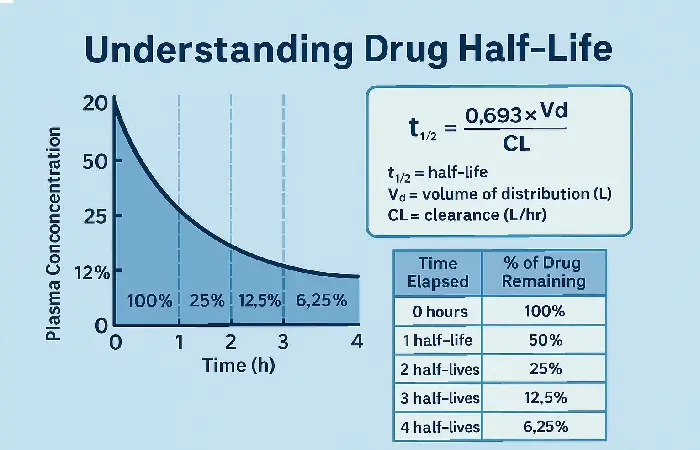
The half-life is the time required for the amount of a drug in the body to decrease by half. OxyContin’s mean apparent elimination half-life is 4.5 hours.
Illustrative half-life model
Not a patient estimate
A simplified example showing how a drug amount can decline by half. It is not a dosing guide or a prediction of a negative test.
Time since dose
9 hours
Illustrative amount remaining
25.0%
0 hours
24 hours
The calculation uses a constant half-life of 4.5 hours. Real drug levels are affected by absorption, repeated dosing and individual differences.
It took about another 4 and 1/2 hours to get this reduced number and it is now 1/2 of the original number. And once again, another 4 and 1/2 hours to get another 1/2 off that remaining amount. This is also why a drug can be “out of the system” in the blood in a short period of time but you can still detect very small amounts of it or its metabolites. For more related articles visit our website.
What affects how quickly oxycodone leaves the body?
Several factors can influence oxycodone concentrations and how long it remains detectable. The most important are:
- Dose and frequency: Higher doses and repeated use can affect how much drug and metabolites are present.
- Kidney function: Oxycodone and its metabolites are eliminated through the kidneys. Reduced kidney function can change exposure.
- Liver function: Oxycodone is metabolised in the liver, so liver impairment can affect its levels and elimination.
- Age and individual metabolism: Drug processing differs between people.
- Test sensitivity: A laboratory’s method and cut-off affect whether a sample is reported positive or negative.
Differences in drug exposure in people with impaired liver or kidney function and in elderly people are noted in the UK Oxy Contin product information. And the FDA says drug-test detection times depend on duration of use, amount taken, and metabolism.
Does OxyContin stay longer than immediate-release oxycodone?
OxyContin is a controlled-release formulation, while immediate-release oxycodone is released more quickly. A SAMHSA clinical reference lists a general urine detection window of 1–1.5 days for immediate-release oxycodone and 1.5–3 days for controlled-release oxycodone.
These are approximate reference values, not a guarantee that a controlled-release tablet will always produce a positive test for longer. A person’s dose, use pattern, metabolism and the laboratory method can change the result.
Can you speed up oxycodone elimination?
There is no reliable home method that can safely guarantee rapid elimination of OxyContin or make a drug test negative by a particular time. Drinking excessive amounts of water, exercising intensely or using so-called detox products cannot be relied on to remove oxycodone safely.
If you take OxyContin regularly, do not suddenly stop or rapidly reduce your dose without medical guidance. Abrupt changes can cause withdrawal symptoms, including sweating, anxiety, nausea, vomiting and diarrhoea.
OxyContin, alcohol and other medicines
OxyContin can cause serious or life-threatening breathing problems, particularly during the first 24–72 hours of treatment and after a dose increase. Combining oxycodone with alcohol, sedatives or certain other medicines can increase the risk of dangerous sedation and respiratory depression.
Tell your doctor or pharmacist about other prescription medicines, over-the-counter products and supplements you take. They can advise on potential interactions and whether your treatment needs adjustment.
When to seek emergency help
An opioid overdose can be life-threatening. Warning signs include slow or shallow breathing, unusual snoring, extreme sleepiness, inability to wake up, limp muscles and pale, blue or cold skin.
If you suspect an overdose:
- Call emergency services immediately.
- Give naloxone if it is available and follow the product instructions.
- Stay with the person and keep them on their side if possible.
- Follow emergency medical advice until help arrives.
Naloxone can reverse opioid overdose effects, but emergency medical care is still essential.
OxyContin and Immediate-Release Oxycodone
| Feature | OxyContin | Immediate-Release Oxycodone |
| Formulation | Controlled-release | Immediate-release |
| Intended release | Gradual release over approximately 12 hours | Faster release |
| Mean apparent half-life | About 4.5 hours | Depends on the product |
| Approximate urine detection window | 1.5–3 days | 1–1.5 days |
FAQs
- How long does OxyContin stay in urine?
Controlled-release oxycodone may be detectable in urine for approximately 1.5–3 days. The actual detection time varies depending on the dose, frequency of use, metabolism, kidney function and testing method.
- How long does OxyContin stay in your blood?
Oxycodone generally has a shorter detection window in blood than in urine. The exact time depends on the test, the dose and when the sample is collected.
- Does OxyContin show up on a drug test?
Yes. A test specifically designed to detect oxycodone can identify OxyContin or its metabolites.
- Can drinking water remove OxyContin faster?
No. Drinking excessive water or using detox products cannot reliably speed up oxycodone elimination or guarantee a negative drug test.
- Can I stop taking OxyContin when it is no longer detectable?
No. A negative drug test does not determine whether stopping treatment is safe. Speak to your prescriber before changing the dose.
Conclusion
The mean elimination half-life of Oxy Contin is 4.5 hours, and the detection window for controlled release oxycodone in urine is estimated to be 1.5-3 days. These are estimates & should be used as a guide only not as a guarantee for any individual. The time it takes for oxycodone to clear your system depends on a variety of factors including dosage, dosage form (tablet, capsule etc.), frequency of use, your kidney and liver function, your metabolism, and the drug test used.
If you are taking Oxy Contin for pain organization, be sure to follow your doctor’s instructions and talk with your doctor or pharmacist prior to making any changes to your medication. If you are concerned about the overdose, do not wait for the drug to clear from your system, pursue backup help in its place.