
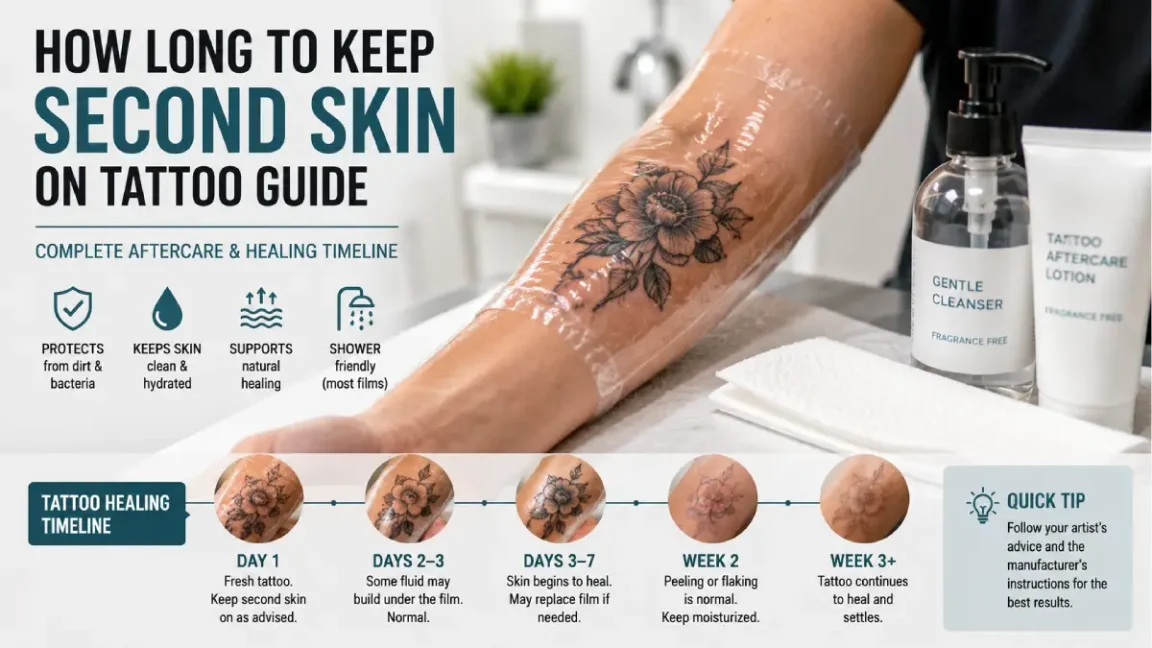
When you’re first fresh out of the shop from a new tattoo, you may be wondering, how long should you keep second skin on tattoo? This transparent adhesive film is gaining popularity among tattoo artists as the primary initial healing dressing. Unlike traditional cling wrap, modern tattoo films like Saniderm adhere to the skin and the person can still shower normally. However, the correct wearing time isn’t exactly the same for every product. Some films are intended to remain on for several days, while the first application of certain products should be removed or replaced much sooner.
Your tattoo is essentially healing skin after a controlled form of skin trauma. Good aftercare therefore means to ensure adequate protection against undesirable irritation, contamination or frictional wear and should be free of unwanted moisture or over-application.
What Is Second Skin for a Tattoo?
” The most common name used is ‘skin’ Second Skin’ refers to a clear, adhesive wrap applied to the skin after getting new body art and tattoo.
Products such as Saniderm are medical-style polyurethane films designed to protect the tattoo while it heals. The film creates a barrier between the tattoo and outside contaminants while still allowing the wearer to see the tattoo underneath.
It is different from ordinary household plastic wrap.
Traditional plastic wrap is normally removed after a relatively short period. A purpose-made tattoo film is designed to remain attached for longer, depending on the manufacturer’s instructions.
Why Do Tattoo Artists Use It?
A new tattoo may secretion small amounts of blood, plasm & ink for the first few hours of healing. A bandage may help defend the tattoo from rubbing off on sartorial, as well as defend the wound from the rudiments such as dust.
However, second skin isn’t compulsory for every tattoo. Some artists prefer traditional aftercare, and aftercare instructions can vary considerably between artists. Research examining 700 tattoo aftercare instructions found substantial variation in the recommendations provided to clients.
How Long to Keep Second Skin on Tattoo?
There isn’t one universal answer because “second skin” refers to several different tattoo-film products.
For Saniderm specifically, the manufacturer’s guidance recommends keeping the initial bandage on for approximately 8–24 hours. It may then be removed, the tattoo cleaned, and a replacement film applied. The replacement can generally remain for several additional days, with Saniderm stating that the second bandage may be worn for up to six days.
A Simple Timeline
| Stage | Typical Saniderm guidance |
| First film | About 8–24 hours |
| First replacement | Up to 6 days |
| Total continuous use | Up to 7 days |
| Heavy leaking | May require earlier removal/change |
| Significant irritation | Remove and discontinue use |
| Water underneath film | Remove and clean the tattoo |
These timings are product-specific, not a universal rule for every second-skin bandage.
Your artist’s instructions should also be considered, particularly if they used a different brand of tattoo film.
What If Your Artist Told You a Different Time?
Don’t automatically follow a generic internet timetable if your tattoo artist gave you specific instructions for the product they applied.
Ask the artist which exact film was used and follow the manufacturer’s instructions for that product.
Can I Take Off Second Skin Early?
Yes, you can remove second skin early when there is a good reason to do so.
You don’t need to keep an adhesive dressing on simply because a particular number of hours has not passed.
Consider removing it if:
- The film is leaking.
- The adhesive has lifted significantly.
- Water has entered underneath.
- The tattoo is becoming increasingly irritated.
- You develop a rash around the adhesive.
- The bandage is causing significant discomfort.
- The tattoo is no longer properly sealed.
As specifically related to Saniderm, removal of the film is recommended if any irritation begins or if the tape is not holding a sufficient seal any longer.
What If the Second Skin Starts Peeling?
Lifting a bit at the edge doesn’t immediately require emergency contact.
If the product lifts enough that your tattoo is exposed to air or is subject to being contaminated by the outside environment, the protective shield has already been broken.
At that point, follow the instructions on your specific product or reach out to your tattoo artist.
How to Remove Second Skin Safely
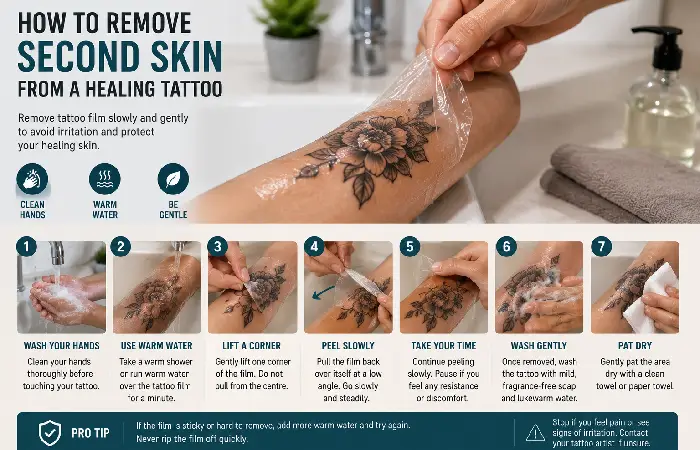
Removing adhesive film too quickly can be painful and may unnecessarily irritate the nearby skin.
For Sandier, the manufacturer’s recommended technique is to loosen an edge and slowly pull the film back over itself rather than pulling it straight upwards. Removing it under warm running water or in the shower can make the process more comfortable.
Basic Removal Workflow
- Wash your hands.
Clean hands are important before touching a healing tattoo.
- Loosen one corner.
Don’t aggressively pick at the centre of the film.
- Pull slowly.
Pull the film back over itself rather than sharply pulling it away from the skin.
- Use warm water if necessary.
Warm water can help loosen the adhesive.
- Wash the tattoo gently.
Use lukewarm water and a gentle, fragrance-free cleanser as appropriate for your aftercare instructions.
- Pat dry.
Avoid rubbing the tattoo with a rough towel.
- Follow your artist’s aftercare instructions.
Depending on the product and healing stage, this may involve leaving the tattoo uncovered or using a suitable aftercare moisturiser.
Can I Shower With Second Skin on?
Generally, yes, if you are wearing a waterproof tattoo film that is designed for showering.
Saniderm states that its bandages are waterproof and can be worn while showering. However, prolonged exposure to very warm water can weaken the adhesive and increase the chance that water gets underneath the film.
How to Shower With Second Skin
Keep these points in mind:
- Use a normal, relatively short shower.
- Avoid very hot water.
- Don’t scrub the film.
- Don’t deliberately soak the bandage.
- Don’t peel an edge back to “check” the tattoo.
- Pat the surrounding skin dry afterwards.
Can You Swim With Second Skin?
A waterproof film does not mean you should go swimming with a fresh tattoo.
Saniderm specifically advises avoiding full immersion in baths, swimming pools and hot tubs during the early healing period, even when the tattoo is covered.
The same principle applies to prolonged soaking in water.
Does Second Skin Make a Tattoo Heal Faster?
It may help create a favourable healing environment, but it shouldn’t be described as a guaranteed way to make every tattoo heal faster.
Second-skin dressings can protect a tattoo from friction and external contaminants and help maintain a controlled environment around the healing skin.
More broadly, medical wound-healing literature supports the principle that appropriately moist wounds can heal more efficiently than wounds allowed to become excessively dry.
Tattoo-specific evidence, however, is more limited. A dermatology review notes that tattoo aftercare practices vary substantially, and there isn’t one universally accepted aftercare routine.
So the more accurate conclusion is:
Second skin can make early tattoo aftercare easier and may support a favourable healing environment, but it isn’t a guarantee of faster healing.
The condition of your skin, tattoo size, location, ink saturation, aftercare and individual healing response all matter.
Benefits of Second Skin for Tattoos
Second-skin dressings can offer several practical advantages.
- Protection From Friction
The film can create a barrier between the tattoo and clothing or accidental rubbing.
- Protection From External Contaminants
A properly sealed dressing can help reduce unnecessary exposure to dirt and other contaminants during the early healing period.
- Less Mess
Fresh tattoos can release plasma and excess ink. A transparent film can contain this fluid during the initial stage.
- Easier Daily Routine
A suitable waterproof film may allow normal showering without immediately removing the dressing.
- Reduced Drying
Appropriate wound hydration can support the healing process. Tattoo aftercare literature also describes maintaining a moist environment as part of certain recommended approaches.
Second Skin Side Effects and Problems
Second skin isn’t suitable for everyone.
Some people develop irritation from the adhesive. Prolonged exposure to adhesive can cause skin irritation or sensitivity, and Saniderm advises discontinuing use if the adhesive is causing excessive irritation.
Possible problems include:
- Itching around the adhesive
- Redness outside the tattoo
- Rash
- Burning or irritation
- Adhesive residue
- Excessive sweating underneath the film
- Leakage
- Film lifting from the tattoo
- Skin irritation from prolonged wear
Tattoo Irritation vs Infection
Some redness, swelling, soreness and clear fluid can be normal shortly after getting a tattoo. As the tattoo heals, itching, flaking and some scabbing can also occur.
However, worsening symptoms should not simply be blamed on normal healing.
Seek medical attention if you develop signs such as:
- Increasing or spreading redness
- Worsening pain
- Pus
- Fever
- Chills
- Painful bumps or a spreading rash
- Open sores
The American Academy of Dermatology recommends seeking medical care promptly when signs of tattoo infection appear.
Do Tattoos Heal Faster, Dry or Moist?
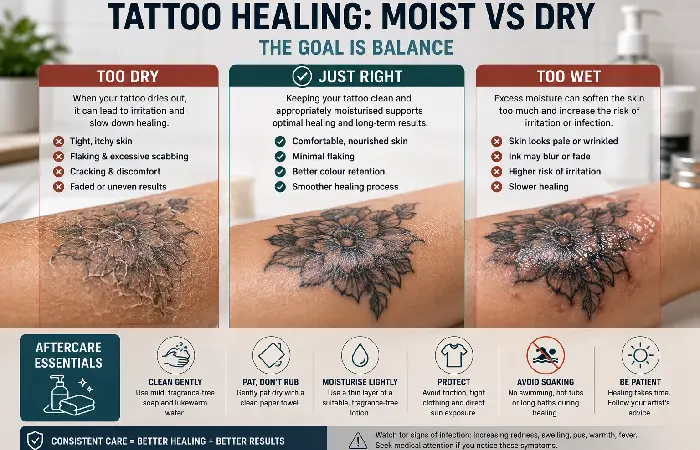
This is one of the most common tattoo-aftercare debates.
The answer is neither soaking wet nor completely dried out.
A healing tattoo benefits from appropriate moisture rather than excessive dryness or excessive wetness.
General wound-healing research has found that appropriately moist environments can support re-epithelialisation and other aspects of healing compared with dry wound environments.
Tattoo-specific European after care guidance has also included keeping tattooed skin appropriately moisturised rather than allowing it to become excessively dry and cracked.
The Goal Is Controlled Moisture
Think of it this way:
Too dry:
Can lead to excessive dryness, cracking, discomfort and potentially more irritation.
Too wet:
Can cause maceration, weaken adhesive dressings and create an unsuitable environment if fluid becomes trapped or the dressing is compromised.
Appropriately moisturised:
Allows the skin to remain comfortable while it naturally repairs itself.
This is why applying a thin layer of an appropriate aftercare product is generally preferable to covering a fresh tattoo in a thick layer of ointment.
Tattoo Healing Timeline: What to Expect
Healing doesn’t happen at exactly the same speed for everyone.
First Few Days
The tattoo may feel sore, warm or sensitive. Some redness and clear fluid can be normal.
Around the First Week
Itching, peeling and flaking may become more noticeable.
Weeks Two to Four
The outer surface usually continues settling, although the tattoo can still look slightly dull or dry.
A tattoo can appear healed on the surface before deeper skin has completely recovered. Saniderm notes that deeper layers can continue healing for considerably longer.
After the Surface Has Healed
Continue protecting the tattoo from excessive UV exposure. The AAD recommends broad-spectrum, water-resistant SPF 30 or higher once the tattoo has healed sufficiently for sunscreen use.
What Should You Do After Removing Second Skin?
Once the film is removed, the next stage is basic skin care.
Recommended General Approach
- Wash your hands.
- Gently clean the tattoo.
- Use lukewarm rather than very hot water.
- Avoid scrubbing.
- Pat the area dry.
- Follow your artist’s recommended aftercare routine.
- Use a suitable moisturiser sparingly if recommended.
- Avoid picking or scratching peeling skin.
- Keep the tattoo away from prolonged soaking.
- Protect the healed tattoo from excessive sun exposure.
The AAD recommends using a water-based lotion or cream if tattooed skin becomes dry and emphasises sun protection for maintaining tattooed skin.
How to Choose the Best Tattoo Artist
Your aftercare starts before you even leave the studio.
Instead of searching for the “best tattoo artist” in general, look for an artist who is experienced with your specific tattoo style and follows strong hygiene practices.
Check Their Portfolio
Look for healed work rather than only freshly completed tattoos. Fresh tattoos can look impressive immediately after the session, while healed examples provide more useful information about the final result.
Look for Relevant Experience
An artist specialising in fine-line tattoos may not necessarily be the best choice for large traditional work, realism or intricate colour pieces.
Choose someone whose portfolio matches your desired style.
Ask About Hygiene
The studio should follow appropriate hygiene and infection-control procedures.
Discuss Aftercare Before the Appointment
A good artist should be able to explain:
- Which dressing they use
- When it should be removed
- What to do if it leaks
- What products they recommend
- What normal healing looks like
- When you should contact them about a problem
Medical literature has highlighted that tattoo aftercare advice can vary significantly between artists, so asking clear questions before leaving the studio is worthwhile.
Common Second-Skin Mistakes to Avoid
Leaving a Damaged Film on Too Long
If the seal is compromised, continuing to wear it may defeat the purpose of the dressing.
Picking at the Tattoo
Don’t peel scabs or flaking skin away manually.
Taking Very Hot Showers
Heat can weaken adhesive and may increase irritation.
Swimming Too Soon
Avoid pools, hot tubs and prolonged immersion while the tattoo is healing.
Applying Too Much Ointment
More isn’t necessarily better. Excessively heavy products can leave the area overly occluded and uncomfortable.
Scrubbing the Tattoo
Freshly tattooed skin should be handled gently.
Ignoring Infection Symptoms
Increasing pain, spreading redness, pus, fever or chills warrant medical attention rather than simply changing your aftercare routine.
Quick Answer: How Long Should You Keep Second Skin on a Tattoo?
If you’re looking for a short answer, check the exact brand of second skin and your tattoo artist’s instructions first.
For Saniderm, the first bandage is generally used for 8–24 hours, followed by a replacement that can remain for several days. Saniderm states that its second bandage can be worn for up to six days, for a maximum of seven days of continuous use.
If the film leaks, comes loose, becomes contaminated or causes significant irritation, it may need to be removed sooner.
Frequently Asked Questions
How long to keep second skin on tattoo?
For Saniderm, the first application is generally kept on for 8–24 hours, while a replacement can remain for up to six additional days. Other second-skin products may have different instructions, so always check the specific product.
Can I take off second skin early?
Yes. If the film is leaking, badly peeling, contaminated, irritating your skin or no longer properly covering the tattoo, early removal may be appropriate. Follow the product instructions and contact your tattoo artist if you’re unsure.
Can I shower with second skin on?
Yes, if the film is specifically designed to be waterproof. Keep showers relatively short and avoid very hot water. Do not swim or soak the tattoo simply because the dressing is waterproof.
Does second skin make a tattoo heal faster?
It can help protect the tattoo and maintain a controlled healing environment, but it isn’t guaranteed to make every tattoo heal faster. General wound-healing evidence supports appropriate moisture, while tattoo aftercare research remains less standardised.
What happens if water gets under second skin?
If water gets underneath the film and the seal is compromised, remove the dressing according to the manufacturer’s instructions, gently clean the tattoo and follow your normal aftercare routine.
Is it better to let a tattoo dry out?
Not necessarily. Excessive dryness can cause cracking and discomfort. Evidence from wound care generally supports an appropriately moist environment rather than deliberately drying a wound out.
How long does a tattoo take to heal?
The visible surface often settles over the first few weeks, but complete recovery of deeper skin can take considerably longer. Healing varies according to tattoo size, location, technique and individual factors.
What are signs that a tattoo is infected?
Increasing or spreading redness, worsening pain, pus, fever, chills and painful or spreading bumps can indicate infection. Seek medical attention if these symptoms occur.
Can I swim after getting a tattoo?
It is best to avoid swimming, hot tubs and other prolonged immersion while the tattoo is healing. A waterproof second-skin dressing does not make a fresh tattoo safe for swimming.
Final Takeaway
Figure out second skin on tattoo duration the days immediately after getting it done don’t have to be overwhelming! A universal answer as to how long you can leave each variety of adhesive tattoo film on the body doesn’t truly exist.
For example, with Saniderm, you’ll likely keep your first application on for only 8-24 hours before swapping the bandage out and keeping your tattoo protected for a few days, with the brand never recommending more than 7 days of consecutive wear.
The idea of keeping a second skin covering is less about preventing the skin from drying and completely healing, rather, it’s more so you can keep your skin clean and protected, but properly moisturized without doing it too often, rubbing on it or scratching it with products.
If ever the pain from your tattoo gets too unbearable, develops additional pain, redness that radiates outward or produces drainage, or you begin to feel warm and feverish, don’t just pass it off as healing, please consult a medical professional.