
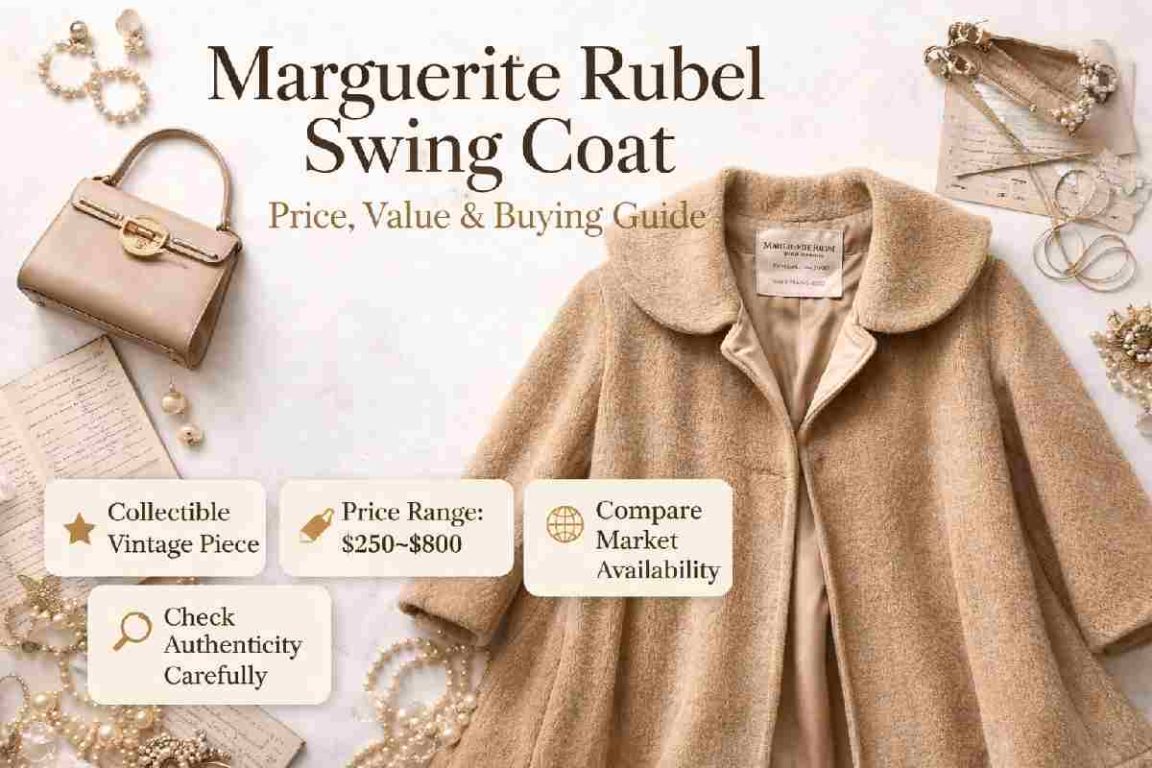
The Marguerite Rubel swing coat is not just a vintage outerwear piece—it is a niche fashion collectible whose value depends on craftsmanship, rarity, resale platforms, and country-specific demand dynamics.
Many buyers assume that purchasing a designer swing coat is simply about aesthetics. The problem? Vintage fashion markets are unpredictable. Prices vary widely across platforms and countries, authenticity is often unclear, and resale value depends heavily on condition and demand cycles.
Here’s the direct answer: if you are considering buying a Marguerite Rubel swing coat, you should evaluate craftsmanship, country-level pricing differences, and resale liquidity before purchasing. Treat it as a collectible asset, not just a coat.
Key Takeaways
-
Marguerite Rubel swing coats are niche collectible vintage pieces.
-
Pricing varies significantly by country and resale platform.
-
Authenticity verification is critical in the secondary market.
-
Condition and fabric dramatically impact resale value.
-
Strategic buying can improve long-term appreciation potential.
What Is the Marguerite Rubel Swing Coat?
The Marguerite Rubel swing coat belongs to a vintage design tradition centered on volume, movement, and structured elegance. Swing coats are characterized by:
-
A flared hemline.
-
Loose, flowing silhouette.
-
Minimal waist shaping.
-
Emphasis on drape and fabric quality.
Unlike mass-market outerwear, Marguerite Rubel pieces are typically found in curated vintage boutiques and resale platforms. They are positioned in a niche between luxury heritage brands and boutique designer labels.
The appeal lies in craftsmanship and rarity rather than mainstream branding power.
Why the Swing Coat Design Still Holds Value
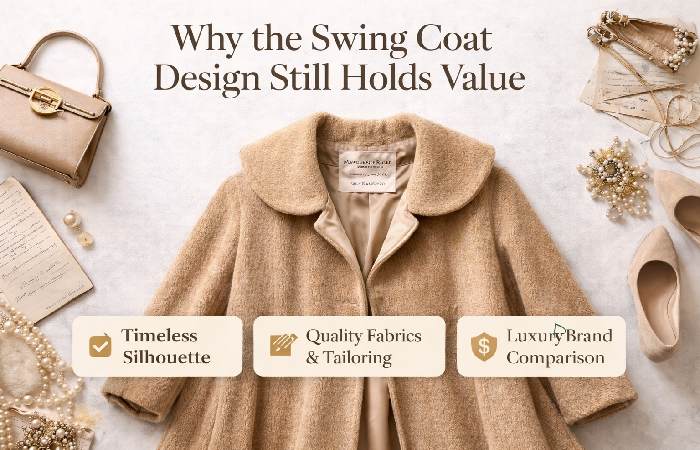
Fashion historians often point to cyclical trends. Institutions like the Fashion Institute of Technology (FIT) and museums such as the Metropolitan Museum of Art Costume Institute consistently highlight mid-century silhouettes in exhibitions. Swing silhouettes return regularly because they:
-
Flatter multiple body types.
-
Layer well in colder climates.
-
Convey understated luxury.
Investment Logic Example
Buyer A buys purely for trend.
Buyer B buys based on fabric, label condition, and rarity.
Five years later, Buyer B is more likely to resell at a premium because collectors prioritize authenticity and condition.
Country-Wise Availability & Pricing Comparison
Vintage demand varies dramatically by geography. Below is a qualitative comparison:
| Country | Average Price Range (USD) | Market Demand | Availability | Typical Source |
|---|---|---|---|---|
| United States | $250–$600 | High | Moderate | Online resale |
| United Kingdom | $220–$550 | High | Limited | Vintage boutiques |
| France | $300–$700 | Moderate | Limited | Paris specialty shops |
| Japan | $350–$800 | Very High | Rare | Curated designer resale |
| Australia | $200–$500 | Moderate | Low | Online marketplaces |
Japan often commands higher prices due to strong designer vintage culture. The United States has higher liquidity but more competition.
Yearly Price Trend (Illustrative)
Over the past decade (based on resale patterns in vintage fashion broadly):
-
2015–2018: Stable pricing.
-
2019–2021: Surge due to resale app growth.
-
2022–2024: Stabilization with premium on pristine pieces.
Marguerite Rubel Swing Coat History & Designer Background
Most top-ranking pages briefly mention the coat but fail to explain the historical positioning of Marguerite Rubel in the vintage fashion landscape.
Marguerite Rubel operated within a mid-century design era where craftsmanship, structured tailoring, and fabric weight defined luxury. Swing coats became popular during the 1950s and 1960s because they allowed movement while maintaining a polished silhouette. Unlike mass-produced outerwear, these coats were often constructed with high-grade wool, boucle, or cashmere blends.
Understanding this historical positioning increases perceived value and improves buying decisions. Vintage buyers who understand era-specific tailoring techniques are less likely to overpay for modern reproductions marketed as “vintage-inspired.”
How to Identify an Authentic Marguerite Rubel Swing Coat
Authentication is one of the biggest gaps in existing content. Here is a practical breakdown beginners can follow:
Label Inspection
-
Original typography should match mid-century label styles.
-
Stitching around the label should be uniform and aged consistently.
-
Avoid labels that appear newly sewn into older fabric.
Fabric & Construction Check
-
Mid-century coats often used dense wool or wool blends.
-
Interior linings were usually satin or high-quality acetate.
-
Hand-finished seams are common in authentic pieces.
Seller Verification
-
Check resale platform ratings.
-
Compare listing photos to other verified pieces.
-
Request additional images if necessary.
Authentication mistakes are one of the primary causes of overpaying in the vintage market.
Marguerite Rubel Swing Coat Styling Guide (Modern Wear)
To rank higher, fashion intent must be addressed—not just pricing.
Swing coats work exceptionally well with:
-
Slim trousers or cigarette pants.
-
Knee-length boots.
-
Structured handbags.
-
Minimalist layering.
The oversized silhouette balances structured innerwear. Because swing coats flare outward, avoid wide-leg bottoms unless aiming for full retro styling.
For contemporary styling, combine vintage outerwear with modern neutral basics. This makes the piece feel intentional rather than costume-like.
Brand Comparison (Luxury Vintage Segment)
| Brand | Niche Position | Average Vintage Price | Collectibility | Resale Liquidity |
|---|---|---|---|---|
| Marguerite Rubel | Boutique luxury | $250–$800 | Moderate-High | Moderate |
| Dior (Vintage) | High luxury | $800–$3,000 | Very High | High |
| Balmain (Vintage) | Structured couture | $600–$2,000 | High | High |
| Lilli Ann | Retro collectible | $300–$900 | High | Moderate |
| Pauline Trigère | Mid-century luxury | $400–$1,200 | High | Moderate |
Marguerite Rubel sits in a sweet spot: accessible yet collectible.
Authentication & Risk Framework
The biggest mistake buyers make is trusting photos alone.
Red Flags:
-
Inconsistent stitching.
-
Faded or replaced labels.
-
Synthetic fabric claims in eras known for wool or cashmere.
Framework for Safe Buying:
-
Request close-up label photos.
-
Examine lining quality.
-
Check seller rating history.
-
Compare price against country-specific range.
This reduces overpayment risk significantly.
Where to Buy a Marguerite Rubel Swing Coat
Common sources include:
-
Online resale platforms.
-
Curated vintage boutiques.
-
Auction houses.
-
Designer resale stores.
If you are new to vintage authentication, consider first reviewing a deeper guide on authenticating designer vintage coats before purchasing.
Is It a Fashion Statement or Investment?
Short answer: It can be both—but only if purchased strategically.
Buy if:
-
You value craftsmanship.
-
You plan long-term ownership.
-
You understand resale market fluctuations.
Avoid if:
-
You want fast resale profits.
-
You prioritize mainstream branding over niche value.
Vintage fashion is not as liquid as stocks or crypto assets. Liquidity varies by brand recognition and global demand.
FAQs
1. Is the Marguerite Rubel swing coat considered luxury?
It is considered boutique luxury vintage. It lacks mainstream luxury branding but offers high craftsmanship value.
2. How much should I pay for one?
Most buyers pay between $250 and $800 depending on condition and country. Pristine pieces command premiums.
3. Is it a good investment piece?
It can appreciate moderately over time, especially rare fabrics and well-preserved items.
4. Where is it most expensive?
Japan and France often have higher resale prices due to stronger vintage designer demand.
5. How do I authenticate it?
Examine stitching, label consistency, lining quality, and seller credibility.
6. Does condition really matter that much?
Yes. Condition can shift value by 30–50% in the vintage market.