

Introduction
Franciscan Health Olympia Fields is not just a local hospital—it is a mid-to-advanced care hub designed for coordinated, referral-driven treatment within the Franciscan Health system.
Many patients search this hospital expecting a simple answer: Is it good? Should I go there? The problem is that most online results reduce it to a directory listing. That leads to poor decisions—wrong entry points, surprise referrals, or mismatched expectations. The solution is understanding how this hospital actually works inside a larger healthcare system.
Key Takeaways
-
Best suited for coordinated, system-based care
-
Strong in planned and escalated treatment paths
-
Less ideal for ultra-specialized tertiary needs
-
Insurance alignment matters more than proximity
-
Knowing entry paths improves outcomes and speed
Location & Geographic Reach (Countrywise Context)
Region/Country Hospital Model Comparison Access Style United States Network hospitals (Franciscan, Mayo, Kaiser) Insurance-driven United Kingdom NHS Trust Hospitals Public referral Germany Regional Specialist Clinics Mixed insurance India Private Multispecialty Hospitals Direct access Japan University-Affiliated Hospitals Referral-heavy
What Is Franciscan Health Olympia Fields—Beyond the Directory Listing
Franciscan Health Olympia Fields operates as part of a regional hospital network, not an isolated facility. That matters. Decisions about diagnostics, admissions, and transfers are influenced by system-wide protocols, not just on-site capacity.
POV: This hospital is optimized for coordination, not one-off convenience.
How Patients Actually Enter the System
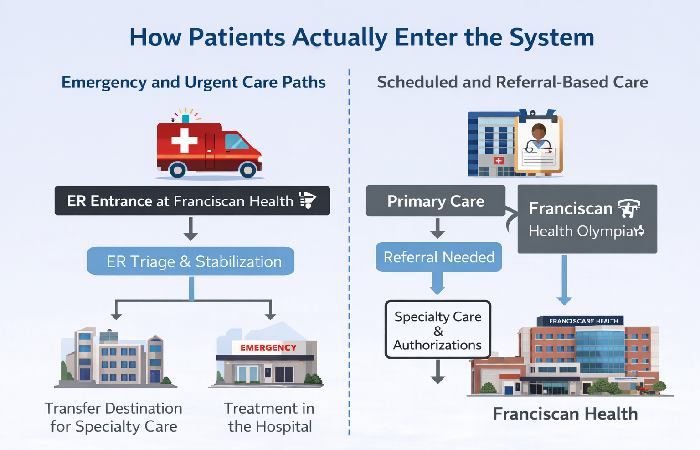
Emergency and Urgent Care Paths
Emergency care prioritizes stabilization and routing. Some cases are treated fully on-site; others are escalated to specialized centers within the network. This is efficient—but surprises patients who expect everything to happen in one building.
Scheduled and Referral-Based Care
Most non-emergency care flows through referrals. Primary care alignment and insurance authorization strongly affect speed and access.
Core Services and Where It Specializes
Rather than listing every department, the practical view is:
-
Strong: cardiovascular evaluation, general surgery support, inpatient medicine
-
Shared: advanced oncology, rare neurological care
-
Redirected: ultra-specialized tertiary interventions
Specialists Availability Table (Healthcare = Service-Specialist Niche)
| Specialty Area | Availability Level | Typical Use Case | Referral Required |
| Cardiology | High | Chronic heart conditions, diagnostics | Yes |
| Orthopedics | Medium–High | Joint issues, post-injury care | Yes |
| Internal Medicine | High | Long-term disease management | No (basic) |
| General Surgery | Medium | Planned procedures | Yes |
| Oncology | Medium (Shared Network) | Cancer diagnosis & follow-ups | Yes |
| Neurology | Limited | Initial evaluation only | Yes |
| Emergency Medicine | High | Acute stabilization | No (basic) |
When Franciscan Health Olympia Fields Is the Right Choice
Example scenario:
A patient with chronic cardiac symptoms benefits from coordinated diagnostics, inpatient monitoring, and network escalation if needed. This is where the hospital shines.
When It May Not Be the Best Fit
-
Rare, experimental treatments
-
Out-of-network insurance without referrals
-
Convenience-driven walk-in expectations
Honest limitation acknowledgment builds trust—and saves time.
Competitive & Geographic Context (Illustrative)
Countrywise Healthcare Provider Comparison (Illustrative)
| Country | Major Hospital Brand | Typical Role | Pricing Level* | Access Model |
|---|---|---|---|---|
| USA | Franciscan Health | Network-based care | $$$ | Insurance/referral |
| UK | NHS Trusts | Universal care | $ | Public referral |
| Germany | Helios Clinics | Specialist hospitals | $$ | Mixed |
| India | Apollo Hospitals | Private multispecialty | $$ | Direct/self-pay |
| Japan | University Hospitals | Advanced research care | $$ | Referral |
*Pricing is qualitative and illustrative, not exact.
Trust, Standards, and E-E-A-T Signals
Hospitals like this operate under nationally recognized accreditation standards and clinical governance frameworks. Benchmarks often referenced include the Joint Commission, CMS quality measures, and NIH-aligned clinical guidelines.
Internal link hook: deeper guide on how US hospital networks differ from standalone hospitals.
Conclusion
Franciscan Health Olympia Fields should be understood less as a “one-stop hospital” and more as a coordinated care node inside a larger healthcare system. Its real value is not convenience or niche specialization, but structured patient flow, referral-driven treatment, and continuity of care—especially for chronic conditions and planned medical journeys.
For patients who align with its network model, insurance pathways, and referral logic, it delivers reliable, system-level care. For those seeking ultra-specialized, experimental, or instant-access services, it may not be the optimal first choice. The smartest decision comes from matching your medical need, urgency, and insurance reality to how the hospital is designed to operate—not how hospital listings make it appear.
FAQs
1. Is Franciscan Health Olympia Fields a full-service hospital?
Yes, but within a network model. Some advanced care is coordinated with sister facilities.
2. Can I go there without a referral?
Emergency care—yes. Many specialty services require referrals and authorization.
3. Is it good for chronic conditions?
Yes. Coordinated, long-term care is one of its strengths.
4. How does it compare to other hospitals nearby?
It emphasizes system coordination over niche specialization.
5. Does insurance choice matter?
Very much. Network alignment affects speed and access.
6. Is it suitable for rare diseases?
Initial care, yes. Definitive treatment may be transferred.
7. Are wait times predictable?
More predictable for scheduled care than walk-ins.
8. Is this hospital research-focused?
It participates in system-wide clinical standards rather than standalone research.
9. Who should not choose this hospital?
Patients needing ultra-rare or experimental procedures immediately.
10. Is it better than a private specialty hospital?
It depends on whether coordination or specialization is your priority.